Anna Sofie
The ChangelingAnna Sofie, the first wife of Nils Knudsen and mother of Agnes Knudsdatter, is a distant ancestor of Jorgen Knudsen whose disappearance marks the human cost of the Knudsen family’s pact with a troll. The history Apollo Kagwa hears does not establish whether Anna Sofie found her daughter or what became of her in the forest. Instead, it leaves her search open-ended, set against a family story in which a father’s bargain determined the fate of a child and the mother who could not accept her loss.
Identity and Journey to New York
Jorgen identifies Anna Sofie as Nils’s first wife and names Nils as his great-great-great-grandfather. In a framed family image, she appears with Nils and Petra Mikkelsdatter, Nils’s later wife. Her place in that image is part of a longer family history, but the account Apollo receives gives her life meaning chiefly through the journey, the birth of her daughter, and the separation that followed.
Anna Sofie and Nils had been married for four years when they boarded the Restoration. Neither was a Quaker; they were willing to seek their fortunes in a new place. Jorgen says it was possible Nils needed to escape Norway, but he cannot confirm that. The ship’s captain offered work to men willing to crew, and Nils bargained for Anna Sofie’s passage. She was already pregnant when they embarked, and she gave birth during the voyage. Their daughter was named Agnes Knudsdatter.
The migration was therefore also the beginning of Anna Sofie’s family life in a new country: she crossed the Atlantic pregnant and gave birth aboard the ship. Yet the account does not describe her later life as a gradual settlement. It turns instead on the loss of Agnes, after Nils had brought his family into a landscape where the old Norwegian bargain would continue to govern them.
Agnes and the Family Bargain
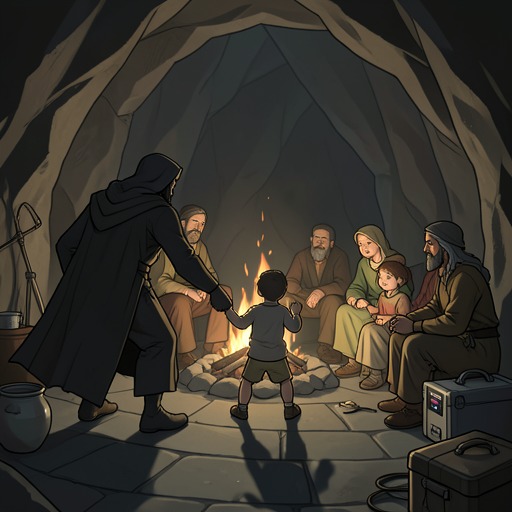
Nils had brought a troll with him as insurance for the voyage and the family’s future. According to Jorgen, the arrangement required him to care for the creature and provide it with a child. After the family remained in Queens, Nils eventually took Agnes into the woods and left her at the creature’s cave. Jorgen presents this act as fulfillment of the bargain; for Anna Sofie, it meant the disappearance of the daughter she had borne on the crossing.
Jorgen says Agnes was dead by the time of the family image Apollo examines. He also says Anna Sofie never recovered from the loss. The account offers no further chronology of her grief or details of how she lived with the separation. It does establish that Nils eventually married Petra, while Anna Sofie’s place in the family story remained defined by the child who was gone and by the search she undertook.
The distinction between Nils’s account of obligation and Anna Sofie’s response is fundamental. The pact could be described as a family duty handed down from an earlier bargain, but it did not make the child’s loss bearable to her. The narrative records that Nils took Agnes away and that Anna Sofie went looking for her; it does not turn her grief into consent to the arrangement or suggest that the bargain resolved what it cost her.
Search and Disappearance
Anna Sofie went into the forest because she wanted to find Agnes and believed her daughter was somewhere there. Jorgen says she never came out. The account does not confirm whether she reached the cave, found Agnes, or escaped with her. When Apollo suggests that she may have found her daughter and fled because Nils could not be trusted, Jorgen answers with a remark that leaves the possibility unconfirmed. Apollo’s conjecture is not evidence of a rescue: Anna Sofie’s fate remains unknown.
Her disappearance is also a contrast within the family’s account of the pact. Nils took responsibility for appeasing the creature and left his daughter in the woods; Anna Sofie rejected the finality of that decision and went after her. Jorgen’s version preserves both actions, but it cannot tell Apollo what Anna Sofie saw or whether her search changed Agnes’s fate. The silence around her end is part of the history rather than a gap the narrative fills with certainty.
Portrait and Narrative Significance
Apollo first encounters Anna Sofie through a framed image that Jorgen identifies as a rendering of Nils’s first wife. Her face is drawn faintly, and her expression seems to Apollo to carry the mark of grief. In the same room, a wall of images arranged across generations depicts infants, none older than a year. The pictures make the family’s repeated dealings with the troll visible as a succession of children’s lives, while Anna Sofie’s image directs attention to the mother left behind by one of those losses.
Her story reaches the reader through Jorgen’s explanation to Apollo, and its limits matter. Jorgen can identify her marriage, her daughter, her search, and her failure to return; he cannot supply a confirmed ending. Apollo offers a hopeful possibility, but it remains his speculation. Anna Sofie thus occupies an uneasy place in the family history: she is remembered through a portrait and through the account of her disappearance, but the conclusion of her search is withheld.
That unresolved absence complicates the Knudsen family’s inheritance. The bargain is transmitted as a way to protect the family and manage the creature, yet Anna Sofie’s actions expose what such a history leaves outside its rules: the mother who seeks the child taken under those rules. The narrative does not settle whether she succeeded. It preserves her as the person who went into the forest after Agnes, and whose fate the family story cannot explain away.